
SKU: BOLP
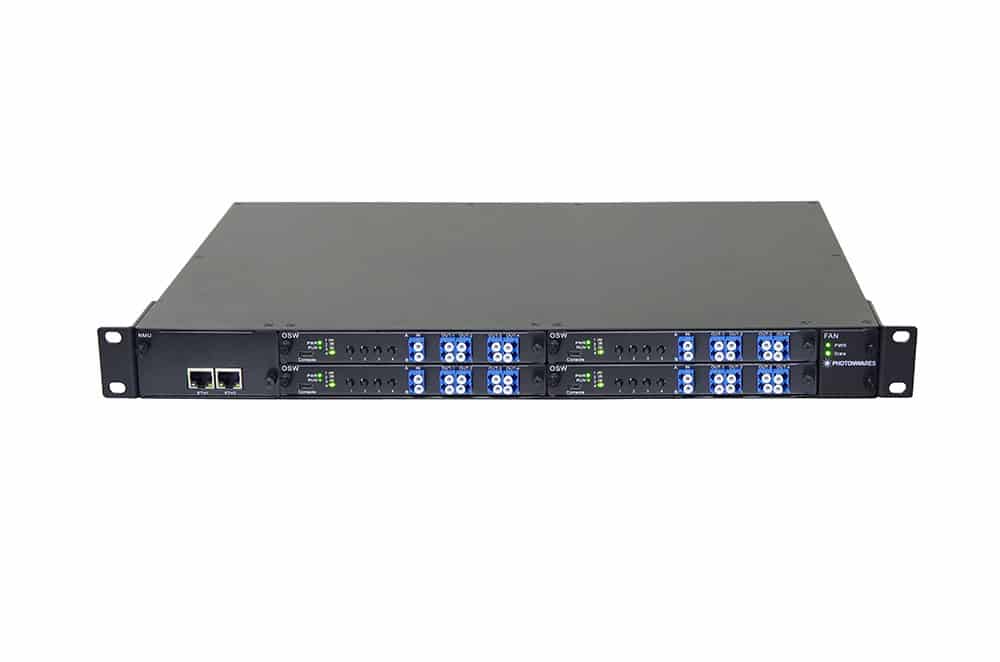
The Agiltron Bidirectional Optical Line Protection (BOLP) System is a carrier-grade, protocol-transparent switching solution designed to provide automatic restoration and non-latching automatic reversion for high-vulnerability single-fiber DWDM networks operating at data rates up to 200 Gbps. The system continuously monitors the optical continuity of the primary link using an out-of-band AUX-band laser pilot signal (typically employing CWDM wavelengths such as 1490nm + 1510nm) transmitted in the reverse direction of traffic at each node. Upon a physical fiber fault or cut, the received AUX-band optical power drops below a user-defined threshold, prompting the internal high-speed optical switches and circulators to automatically reroute the bidirectional DWDM traffic onto a geographically diverse backup fiber path in under 10 ms (with high-speed variants supporting 100 µs or 10 µs switching). Following a protection event, the centralized head-end hardware continues to actively probe and monitor the primary fiber link; once physical continuity is fully restored and a stable AUX laser signal level is verified above the threshold, the system automatically triggers a seamless reversion back to the primary path. This reversion logic features integrated transient stability metrics, rendering it completely immune to false switching cycles caused by premature Fresnel reflections during fiber splicing or connector reconnection. To maximize deployment efficiency and keep the Outside Plant (OSP) 100% passive, the BOLP system interfaces directly with uniquely engineered passive DWDM filters optimized for distinct network architectures. In a Cascaded (Daisy-Chained) Topology, passive OSP Optical Add-Drop Multiplexers (OADMs) are linked via their Expansion (EXP) ports over a single fiber, where the EXP port of the final OADM in the linear chain—ordinarily left unpopulated—is routed back to the central hub via a diverse fiber path to form a closed physical ring. Because Agiltron 1-fiber (1F) OADMs are inherently bidirectional and simultaneously broadcast add/drop channels to both their IN and EXP ports, the head-end hub can actively monitor primary link health even while active traffic traverses the backup path, triggering an automatic reversion the moment the primary fiber break is spliced and the AUX signal stabilizes. Alternatively, in a Hub & Spoke (H&S) Topology, where the fiber spectrum is coarsely partitioned at a centralized field location using a passive Band Splitter/Coupler (BSC) to feed localized sub-bands to downstream destinations, the linear distribution spurs maximize the optical budget but do not natively accommodate protection loops. Consequently, the BOLP system consolidates protection on the main head-end trunk line between the central hub and the BSC cabinet, utilizing dual independent protection switching modules to monitor aggregated optical power and the AUX pilot signal. If the main trunk line is severed, traffic is instantaneously forced over a secondary backup trunk fiber, and the moment primary trunk continuity is restored, the hub commands an automatic reversion back to the optimized primary link—ensuring the entire downstream spoke ecosystem transitions seamlessly back to the high-budget path without requiring field component intervention. Engineered for maximum uptime, the BOLP chassis features full hardware redundancy, utilizing dual hot-swappable DC power supplies (operating from -42 VDC to -70 VDC) and dual independent Ethernet communication controllers that feature automatic failover and proactive SNMP v3 alarm reporting, while each individual plug-in module provides a front-panel physical manual override push-button with a dedicated status LED to enable immediate bypass routing to a third port for local circuit maintenance and loopback testing.
Due to inherent computer delays under Windows, response speed can be improved by using a Linux-based controller or executing stored switching sequences directly on the board. In this mode, the host computer simply issues start, pause, and repeat commands.

Reviews
There are no reviews yet.